
Can Trust Be Taught? Reflections on Fear, Letting Go and Learning to Trust
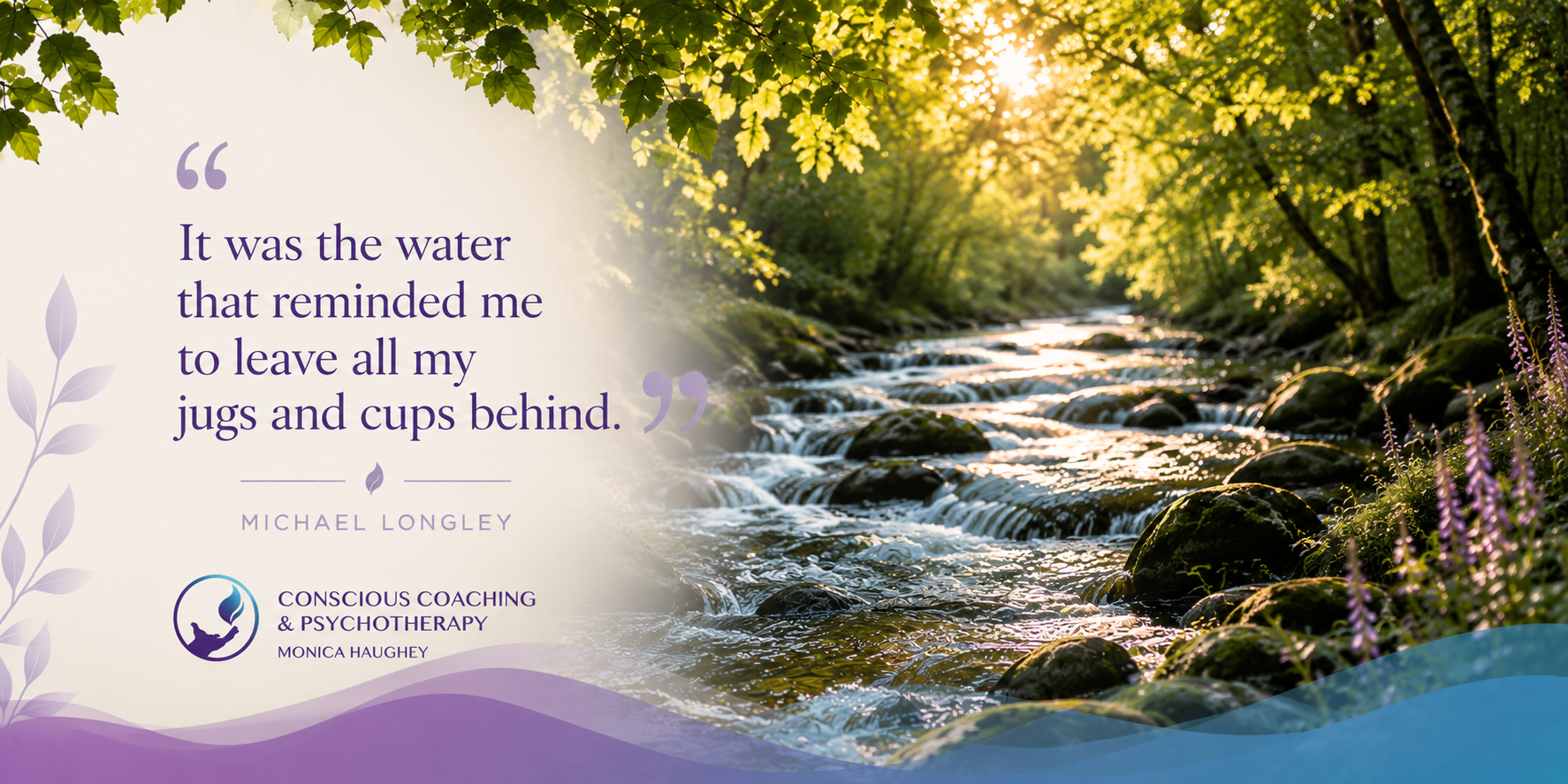
"It was the water that reminded me to leave all my jugs and cups behind."
— Michael Longley
I have always loved this line from Michael Longley.
There is something about it that invites to surrender, to letting go of what we feel we need to carry, and perhaps most of all, to trust.
Recently, in supervision, a psychotherapist shared concerns about a colleague who had unintentionally fallen into the pattern of continuing to see clients indefinitely. Beneath the practical and ethical considerations, there seemed to be another story unfolding – one rooted in fear.
Fear that if these clients moved on, there might not be others to take their place.
Fear that there would not be enough.
It led us into a deeper conversation about trust.
Trust in ourselves.
Trust in our own abilities and worth.
Trust that endings create space for new beginnings.
Trust that what is meant for us will not pass us by.
Trust in that we will be guided and that things will work out.
Holding On "Just in Case"
So often, fear encourages us to hold on tightly – to relationships, careers, roles, identities, habits, or opportunities that may no longer serve us.
We cling just in case.
Just in case there isn't enough.
Just in case nothing else comes along.
Just in case we make the wrong decision.
Sometimes, holding on can feel safer than stepping into uncertainty. Yet, what if the very act of holding on prevents us from making space for something new?
As my supervisee reflected on this situation, she recognised that her client might need to learn trust.
But it left me wondering:
Can Trust Actually Be Taught?
Or is trust something we cultivate through experience?
Perhaps trust develops through repeatedly taking small risks, surviving moments of uncertainty, and discovering that we can navigate whatever comes next.
I suspect many of us wrestle with trust at different points in our lives.
Trusting ourselves to make decisions.
Trusting others enough to ask for support.
Trusting that we are capable of handling change.
Trusting that life may hold possibilities we cannot yet see.
For many of us, past experiences have taught us that trust can be risky. Disappointment, loss, or uncertainty can leave us cautious and protective.
And yet, there comes a point where the armour that once protected us can begin to restrict us.
Learning to Trust Again
Perhaps trust isn't about certainty.
Perhaps it isn't about believing that everything will unfold exactly as we hope.
Perhaps trust is about taking the next small step without needing to know the entire path.
It may be found in choosing to release what no longer serves us.
In allowing endings to happen naturally.
In noticing where fear has become the driving force behind our choices.
And in gently asking ourselves:
What am I holding on to because I am afraid?
What might become possible if I loosened my grip?
Where in my life is trust asking to be strengthened?
The answers may not come immediately.
Like water, trust may ask us to soften, to adapt, and to move gradually around the obstacles in our path.
But perhaps, little by little, we can learn to trust ourselves more deeply.
And maybe, just maybe, that is enough.
A Reflection
As I return to Michael Longley's words, I wonder whether the invitation is not to abandon all that we have gathered, but to notice when we have become burdened by what we carry.
To recognise that there are times in life when we are called to set down our jugs and cups.
To trust that what we truly need will still be there.
And to step forward with openness towards what is yet to come.
I'd love to hear your thoughts.
Can trust be taught? Or is it something we can only learn through experience?
If themes of trust, fear, transition, or alignment resonate with you, conscious coaching offers a supportive space to explore what may be emerging in your life.
You can find out more about my approach to conscious coaching, or arrange a complimentary introductory call by clicking on the button below.
What is Conscious Coaching?
Read more in my last blog by clicking the link here.
